

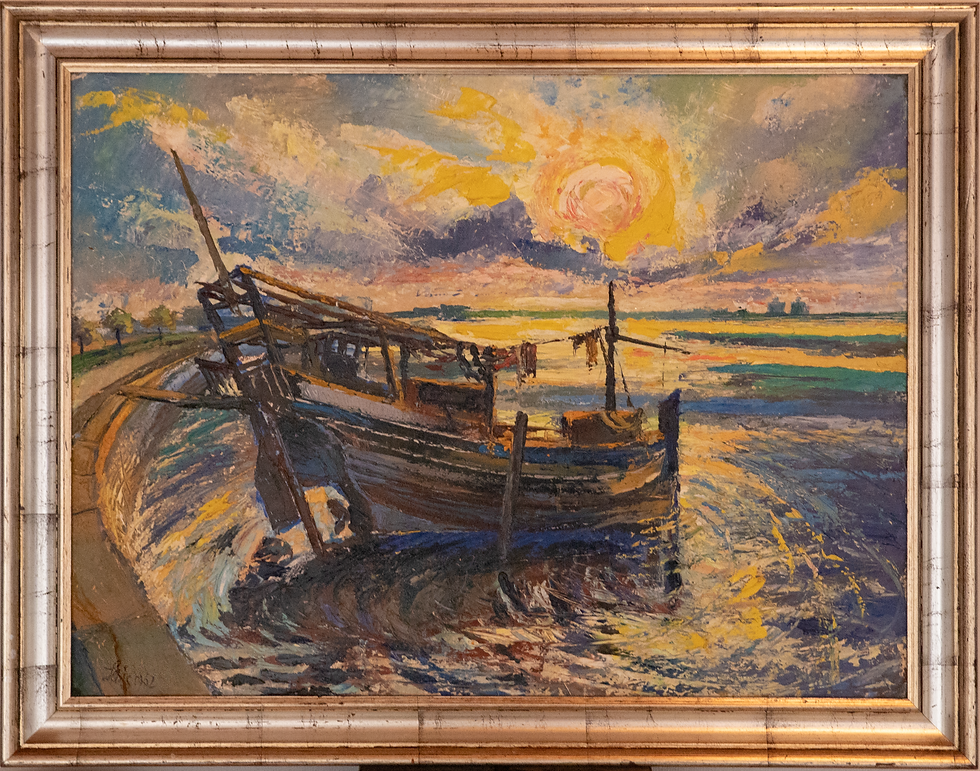

1962 - Manama skyline from old Muharraq causeway
Oil on canvas
The 1960s
Following the accession of HH Shaikh Isa Bin Sulman Al Khalifa, Lewis returned to Bahrain to work directly on behalf of the Ruler, with his wife and baby daughter
The family stayed at the Speedbird House for several months awaiting the completion of their new house. This BOAC guest house was the only hotel on the island at the time.
Lewis’ first known landscape was painted in 1962. This view of Manama with a dhow in the foreground is a view from the Muharraq end of the old causeway; which had a mechanically controlled section, that spun around to allow dhows to pass through.
The style is highly impressionistic, in thick impasto; always Lewis’ favourite method of painting in oils. It evokes the heat of the early morning sun, and you can almost smell the fine film of diesel lying on the water’s surface, reflecting the iridescent colours of the sky.
From these early days Lewis was entranced by the rich, jewel-like colours of the sea surrounding Bahrain. And his love of painting dhows developed from this period, when he had more time to paint en plein air.
It is interesting to note that, on the right side of this painting, there are two prominent square structures standing tall against the relatively flat Manama skyline. These are the twin towers of the brand new Almoayyed Building, which dominated the skyline for the rest of the decade.

Ariel view of old Manama circa 1960's
Photograph courtesy of ???????

The early ‘60s saw a burst of new buildings, as Bahrain begun its journey of development into a modern nation. In 1962 construction begun on Bahrain’s first 4Star hotel - The Delmon Hotel.
Lewis was commissioned by the owning Zayyani family, to paint a mural depicting Bahrain. Measuring 5.5 by 3 meters, this elaborate painting stretched across the Lobby greeting guests until the late ‘90s


Mural painted by Lewis Morland in 1963
Photograph courtesy of The Morland Family

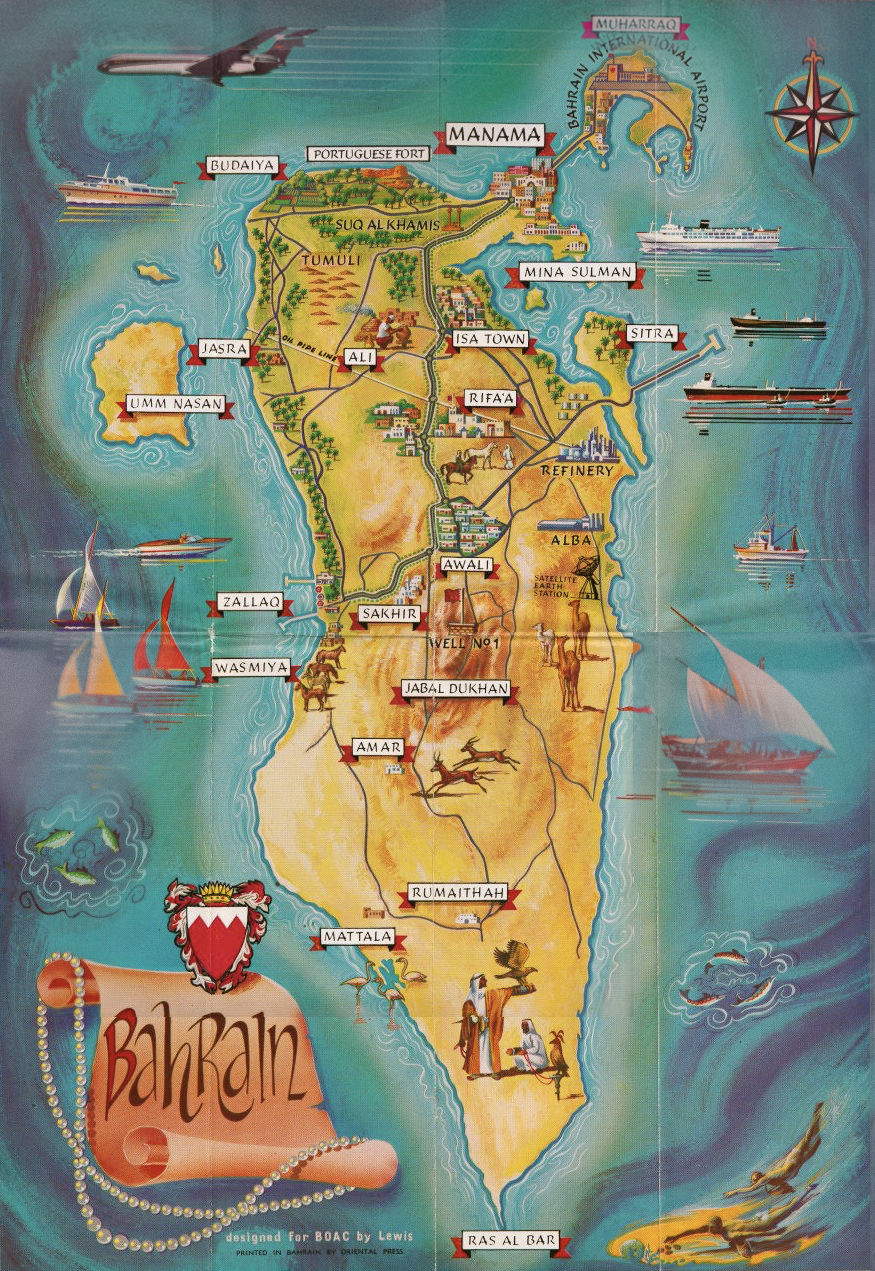
Frontispiece of map of Bahrain commissioned by BOAC in ????????
Photograph courtesy of The Morland Family
XYZ PAINTING CIRCA LOREM IPSUM
"Lorem ipsum dolor sit amet, consectetur adipiscing elit, sed do eiusmod tempor incididunt ut labore et dolore magna aliqua. Ut enim ad minim veniam, quis nostrud exercitation ullamco laboris nisi ut aliquip ex ea commodo consequat. Duis aute irure dolor in reprehenderit in voluptate velit esse cillum dolore eu fugiat nulla pariatur. Excepteur sint occaecat cupidatat non proident, sunt in culpa qui officia deserunt mollit anim id est laborum."

HH Shaikh Isa Bin Sulman Al Kahlifa is presented with the original artwork by Lewis Morland and the managing director of BOAC Bahrain.
Photograph courtesy of The Morland Family
By 1964, and at the express invitation of the Ruler, HH Shaikh Isa, Lewis began his designs for Bahrain’s first original and definitive stamps.
Until then, British stamps overprinted with a country’s name, was common practice in all colonies and dependencies. But at this time many small countries with few economic assets, jumped on the lucrative band wagon of producing issue after issue of highly decorative and attractive stamps. First day covers were aimed at international collectors as a legitimate source of national revenue.
This was obviously on the mind of Ricky Thorpe the Postmaster General as seen by a revealing paragraph in his letter to Lewis, dated … ………..,.
Insert letter
The Postal Directorate felt an edition depicting aspects of Bahrain’s industrial development, such as the new airport at Muharraq, and the modern port of Mina Sulman would suffice.
But Lewis saw this commission as an opportunity to showcase Bahrain to the world. He agreed that the modern subject matter be dedicated to the lower denominations and designed them accordingly. But Lewis insisted he personally choose the subjects for the higher denomination stamps.
Insisting each should depict an aspect of Bahrain’s national character, culminating in the distinctive One Dinar stamp. Still immediately recognised by stamp collectors around the world.
The Pearl Diver
The economic importance of pearl fishing cannot be overstated. It was the basis of the island's wealth for centuries. Archeological evidence shows Gulf pearls were traded with Mesopotamia c500 BC. And Gulf pearls were the most prized jewels of all European courts from the 1500s onwards.
Early on, Bahrain became the centre of pearl trading with merchants from Italy to Samarkand plying their trade here.
The Arab navigator, Ahmad Bin Majid, visited Bahrain in 1489 prior to the Portuguese' arrival in the region and gave an account of the country: "In Awal (Bahrain) there are 360 villages and fresh water can be found in a number of places. A most wonderful al-Qasasir, where a man can dive into the salt sea with a skin and can fill it with fresh water while he is
submerged in the salt water. Around Bahrain are pearl fisheries and a number of islands all of which have pearl fisheries and connected with this trade are 1,000 ships" (Majid, Arab Navigation in the Indian Ocean before the Coming of the Portuguese. Trans.
G.R. Tibbetts. The Royal Asisatic Society of Great Britain and Ireland, 1981. page 222).
By the late 1920s more than 2,000 pearling boats operated from Bahrain.
But the industry fell into sharp decline with the development of Japanese cultured pearls in the mid 1930s.
Arabic Coffee
The pouring of a cup of Arabic coffee to welcome your guest, has long been recognised as a symbol of hospitality. This national characteristic is one Bahrain can be proud of. It is interesting to note that the coffe pot
in this stamp is the same one that can be seen in the crafts of Bahrain. month, showing the coffee pot maker.
This beautiful, ornate, brass coffee pot was given to Lewis by his highness, Shaikh, Salman bin Hamed Al Khalifa in 1959, whilst painting his official portrait. It is a coffee pot that will re-occur many times during Lewis’ life’s work and is still a treasured family possession.
Falconry and the Horse
Through the centuries, Arabia was famous for its prized Arabian horses. And the skill of the Arab rider is legendary. These regional traditions were upheld in Bahrain, and considered an integral part of the Island’s culture. In recognition of his love of Falconry, His Highness Shaikh isabinsulmanalkhalifa chose to be painted with his favourite falcon in his first official portrait painted by Lewis.
The accoutrements depicted both in this portrait, and seen again in the Equestrian and Falconry Stamp; the stand, arm protector and leather mask, were given to Lewis by HH Shaikh Isa and still belong to the family.
The new, young Ruler continued his father’s weekly tradition of horse racing every Friday, at the racecourse situated between Riffaa and Awali. An event Lewis and his family attended every week for many years. Eventually the old racecourse was superceded by the magnificent grass-laid courses built at Sakhiyya and Riffaa where international events are held today. Further testament to the importance of equestrian sports in Bahrain’s cultural life.
The One Dinar Stamp
This can be seen as a …….. of all that made Bahrain special in the eyes of the artist. Here the Bab Al Bahrain (The Gateway of Bahrain) is seen, for decades the main port of Manama.
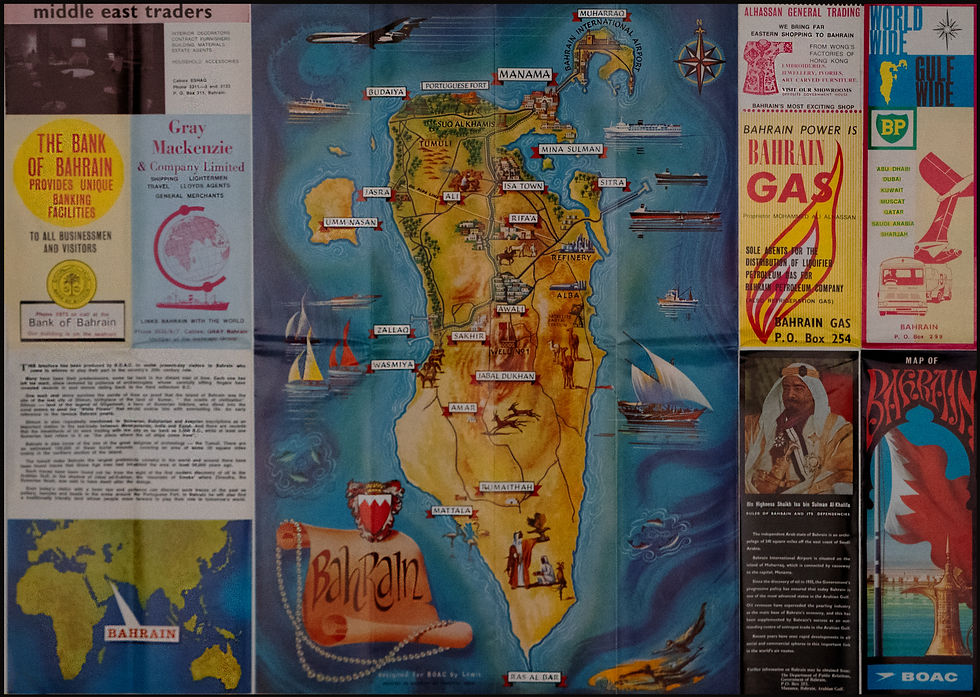
Full fold-out of the map, showcasing ads created by Lewis Morland for prestigious companies of the time.
Photograph courtesy of The Morland Family

Reverse side of the full fold-out, including additional ads for leading companies designed by Lewis Morland.
Photograph courtesy of The Morland Family

Lewis Morland Art
Proudly curated by the Morland and Richards family.
© 2025 ALL RIGHTS RESERVED LEWISMORLAND.COM & LEWISMORLANDART.COM